AB Telegraphist Arthur William (Bill) WHITE
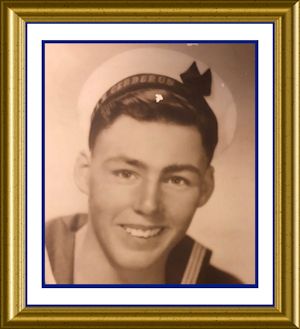
Arthur William (Bill) White was born in Winchester in the
Carramar District of Western Australia on 16 June 1922, the
son of Arthur and Florence White.
Bill enlisted in the RAN on 20 October 1939, before
proceeding to HMAS Cerberus for recruit training
and specialist training as a Telegraphist. His
Telegraphist training was comprehensive, including morse
code and maintenance of the transmitting and receiving
equipment.
On completion of his training at Cerberus, Bill was
posted to the troop ship RMS Aquitania. Here
he experienced the benefit of being a member of the senior
service; the billet aboard Aquitania provided for
cabin accommodation and level 2 Stateroom dining. This
created some intense discussion on-board, however, the
Captain deemed that the RAN personnel formed part of the
ship’s company and as such endorsed their entitlement.
Bill later reflected on his training:
I did pride myself on my Morse capability, however, that
coupled with my acknowledged non-fear of heights and slight
frame did put me at the front of the queue when it came to
clamouring up the 60ft aft mast to clean the communication
equipment. Or being selected to carry the transmitting
equipment on my back on spotting exercises ashore.
Bill subsequently joined RMS Mauretania before
travelling to Colombo, where he joined the Modified Leander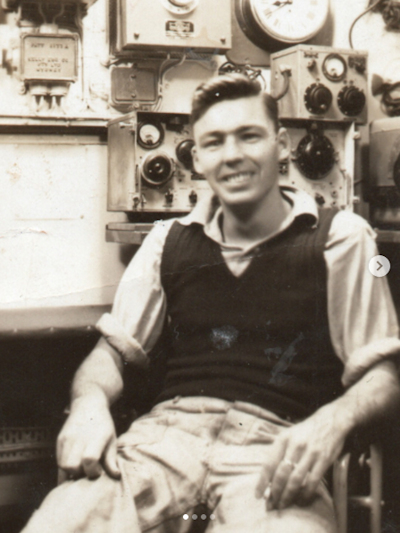 Class light cruiser, HMAS Hobart, on 26 October
1940. Hobart, under the command of Captain
Harry Howden, RAN, returned to Sydney on 3 January 1941
where she became the Flagship of Rear Admiral (later Admiral
Sir) John Crace, RN, Commanding the Australian Squadron.
Class light cruiser, HMAS Hobart, on 26 October
1940. Hobart, under the command of Captain
Harry Howden, RAN, returned to Sydney on 3 January 1941
where she became the Flagship of Rear Admiral (later Admiral
Sir) John Crace, RN, Commanding the Australian Squadron.
During the first half of 1941, Hobart operated
chiefly on the Australia station and in New Zealand waters.
On 20 June Hobart sailed from Sydney arriving at
Port Tewfik, at the southern end of the Suez Canal, on 12
July.
During the next five months Hobart operated from
Alexandria, Egypt, participating in the Mediterranean
campaign as part of the Royal Navy’s 7th Cruiser Squadron.
She routinely ferried troops in support of the campaign in
the Western Desert and took part in shore bombardments of
both Tobruk and Bardia during October and November 1941.
The cruiser was also involved in operations off Cyprus,
Malta and Syria as well as participating in a number of sweeps
with the Royal Navy 1st Battle Squadron in company with HM
Ships Queen Elizabeth, Barham and
Valiant. Throughout her deployment, Hobart
was subjected to frequent air attacks both at sea and in
Alexandria, however, her luck held and she suffered no major
damage.
Bill’s role had him close to the action and he
took care to be aware of what was happening around him, he
reflected on this point later:
I was always focused on the tasks at hand and was
interested in what was happening around me. I guess
that was the observer factor in me. Consequently, I
thought little about these events from an anxiety
perspective, and accordingly I maintained a good
recollection of events, interaction between key personnel
and the important historical communications from Fleet.
But on consideration we did witness some terrible loss of
life.
Bill spoke of the power and presence these massive
fortresses of steel commanded, crewed by thousands of men,
and remembered witnessing the explosion and sinking of HMS
Barham after being hit by a torpedo from German
U-Boat U-331 and the frenzy the communications lines went
into.
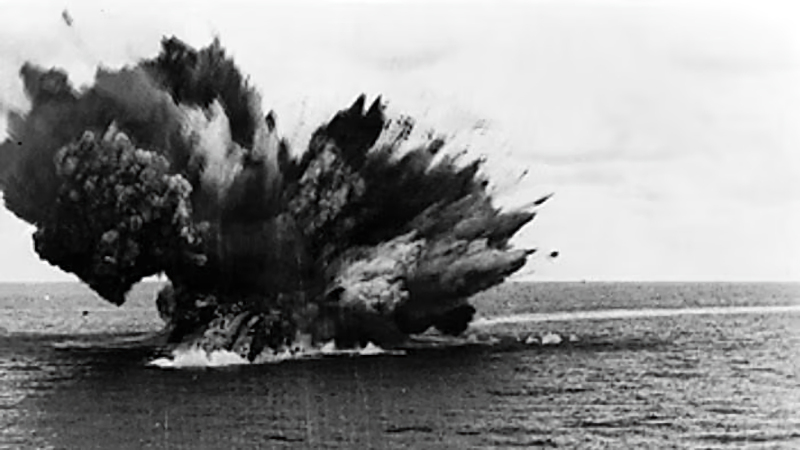
RN battleship HMS Barham
explodes after it is attacked by German submarine U-331 in
the Mediterranean Sea during World War Two (II) on
25/11/1941, with crew of 841 men lost. Pic from Imperial War
Museum.
Bill maintains that:
"We were lucky and never took serious
damage. We had a great leader but there is always that
element of luck and sadly I did witness a significant loss of life.
However, the Mediterranean campaign did come with
an unexpected surprise from home.”
Arthur White Senior had migrated to Australia from
England in 1911 and enlisted in the AIF on 14 September
1914.
He was wounded in action in May 1915 and later became aide
to General Sir Cyril Brudenall Bingham White (Lieutenant
Colonel at the time) who became famous for the successful
evacuation of Australian troops from Gallipoli.
A card reading “To Arthur, my loyal and faithful friend,
signed CBBW” holds pride of place with Bill’s extended
family.
Bill said his father was a veteran of both Gallipoli and the battles of the WWII.
"He reenlisted under a false name and age and wound up with
a unit composed of mostly miners from Ballarat."
His father’s unit was then posted to Alexandria and Bill
said seeing his father randomly on the opposite side of the
world was a great surprise.
“Someone said to me, there’s a brother of yours here and I
said, what do you mean?”
With the entry of Japan into the war, Hobart
transferred to Far East waters becoming part of the
American, British, Dutch and Australian (ABDA) forces
operating in Southeast Asia.
On Sunday 1 February 1942 Hobart berthed at Keppel
Harbour, Singapore. By then the Japanese army had
breached the causeway and a desperate rear-guard action was
being fought by Allied soldiers. Hobart took
on ammunition and stores and prepared to depart the island.
Seven air raids were recorded during the day and a
considerable number of bombs fell into the harbour.
Hobart and HMS Tenedos cleared the harbour
at 18:00 on 2 February and shaped a course for Tanjong Priok
in the Dutch East Indies. Singapore was clearly lost
and its surrender on 15 February came as no surprise.
Bill would later remark on the departure of Hobart
from Singapore:
In that short window of opportunity, the sailors made a
raid on the warehouse adjacent to the ship and secured a
bucket load of Singer sewing machines and some beer.
And of course Hobart commandeered anything of value to deny
the enemy, including a 1939 Austin Tourer, which was
off-loaded when we were next in Fremantle. Our mate
Ernie Solway became Captain Howden’s driver after the war at
HMAS Leeuwin, and during our regular catch-ups in
Maroochydore years later, Ernie recalled fond memories
driving the good Captain around in his pride and joy - the
Austin Tourer.
The following weeks were extremely arduous for Hobart
as WWII raged on, Bill takes up the story:
After leaving Singapore we headed to Tanjong Priok. En
route we encountered the merchant ship Norah Moller, under
attack by enemy aircraft. The initial wave was beaten off
but further attacks took their toll. The wounded and dead,
including women and children, were taken on board Hobart and
HMS Tenedos. The dead were buried at sea and 6 of the 28
survivors died before we reached Tanjong Priok.
We continued to operate as part of the ABDA forces in the
Java Sea and experienced relentless attacks by the Japanese
aircraft. Toward the end of the month we were in Tanjong
Priok fuelling alongside a tanker. I recall waving goodbye
to our comrades on HMAS Perth as she sailed out the heads
fully expecting to follow once fuelled. But once again we
came under heavy attack, to the extent that we were forced
to break away from the tanker without completing the
fuelling. We consequently headed in the opposite direction
seeking fuel and missed the Battle of Java Sea. That was the
very best and worst of luck.
We ultimately returned to Sydney via Colombo and Fremantle,
stored ship and carried out repairs and then sailed with
HMAS Australia and USS Chicago to join the main Task Force
73 under command of RADM Fletcher in the Coral Sea.
Hobart took part in the western ‘extension’ of the
Battle of the Coral Sea in May 1942. One of the
covering force for the United States aircraft carriers.
Bill later reflected on the battle:
We experienced significant exposure to the relentless
and determined attack by the Japanese with limited allied
air support; once again we came through with flying colours.
I did observe a lot during this period, and in subsequent
times I also reflected on why we were such an effective
team. I have no doubt that our Captain must take a great
deal of the credit, our ship was a floating fortress,
manoeuvred by a skilled navigator and this, combined with
our significant exposure to combat, moulded our ships
company into a very effective force. The men held Captain
Howden in high regard and he in turn looked after his men.
This was very evident when we disembarked in Brisbane after
the Battle of the Coral Sea, we celebrated our survival and
comradeship - and Captain Howden.
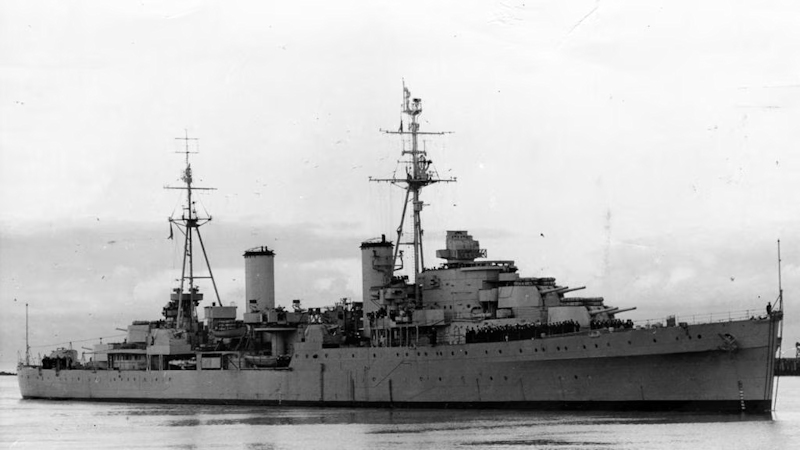
HMAS Hobart, Leander-class
light cruiser which served in the RAN during World War II.
HMAS Hobart berthing at Outer Harbor in May 1946. (Copyright
The Advertiser photograph Krischock)
Bill’s posting on Hobart ended on 31 May 1942, a
significant date in the history of Sydney:
I left Hobart and headed to Sydney only to arrive on the
morning after the attack on Sydney Harbour by the miniature
Japanese submarines. It was a great shock and quite chaotic.
About a week later we marched through Sydney and were then
transported to Rookwood Cemetery to honour and bury our
dead. And, in the tradition of the mariner, we also
honoured the dead of our enemy.
Shortly after this I was sent to Townsville to board a ship
for Milne Bay, as part of a wireless team tasked to improve
the wireless system, specifically the Port Directive system
for ships. On arrival we transferred to a yacht and
travelled to Lai and Buna.
I spent approximately 12 months working between the various
islands. It was not a very pleasant experience, as we all
suffered with the broad variety of jungle illnesses,
malaria, dysentery etc. also having teeth removed, leg
infections lanced without anaesthetic, all the time putting
on the tough ANZAC face in front of the American medics.
I returned to HMAS Cerberus to commence a promotional course
only to be struck down with the ‘Big Fella’ - Malignant
Malaria. It must have been a close run thing because they
flew my sister over from Perth. Malignant Malaria is among
the most severe human infectious diseases and very often
fatal, but should you survive, at least you do not normally
experience post malaria attacks. Captain Howden was
Commanding Officer of Cerberus at the time and I was an Able
Seaman; but one of Harry’s Hobart men!
Following my recovery I went to Sydney to commission HMAS
Wallaroo and conducted the maiden voyage to Fremantle. On
the morning of 11 June 1943 I was admitted to hospital and the
Wallaroo sailed at midday, only to collide with the United
States Liberty Ship Henry Gilbert Costin and sink later
that night.
In comparison the remainder of my service was rather sedate
until my discharge.
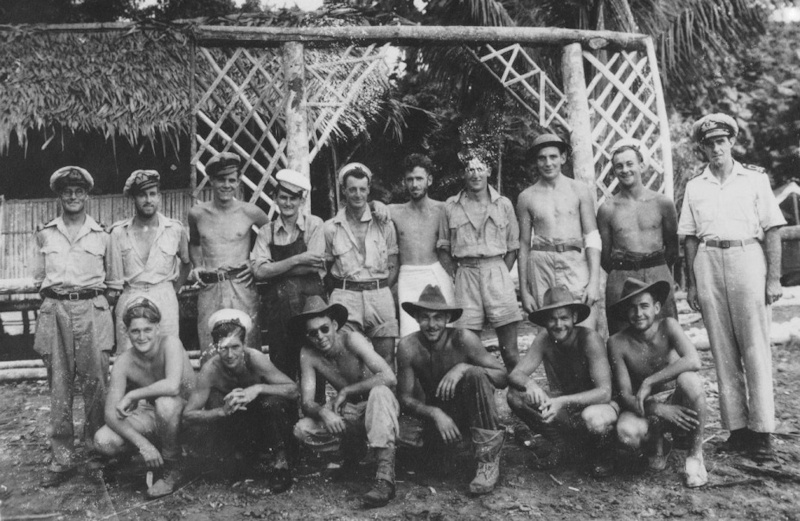
Bill (third from left, front row) spent time in the remote
islands around Papua New Guinea
tasked with improving the
wireless systems found in the area.
Family and Post War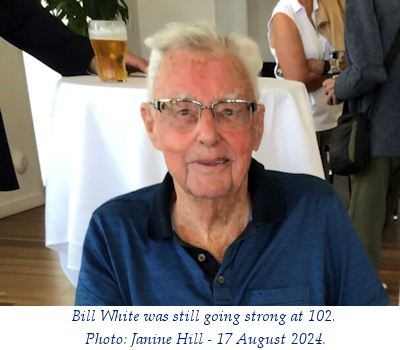
Bill married Rita in 1944 and remained happily married for
70 years. They had a son, Peter, who has since passed.
After leaving the Navy in 1947 Bill took advantage of the
significant repatriation points accumulated during his
service and took a bridging course in carpentry.
Bill was soon working in the construction industry, where he
ultimately became the Queensland and Sydney Manager for the
major Development Company ANKA, remaining there until his
retirement.
During his time with ANKA, Bill presided over the
development of major retail and high-rise projects in
Sydney, the Gold and Sunshine Coasts and Mareeba. His
projects included the Sands Shopping Centre in Maroochydore,
ultimately renamed The Sunshine Plaza.
Sadly, ABTEL Arthur William "Bill" WHITE, o/n 23686, the
last survivor of the Battle of the Coral Sea, passed away on
the eve of his 104th birthday, 15 June 2026.
LEST WE FORGET
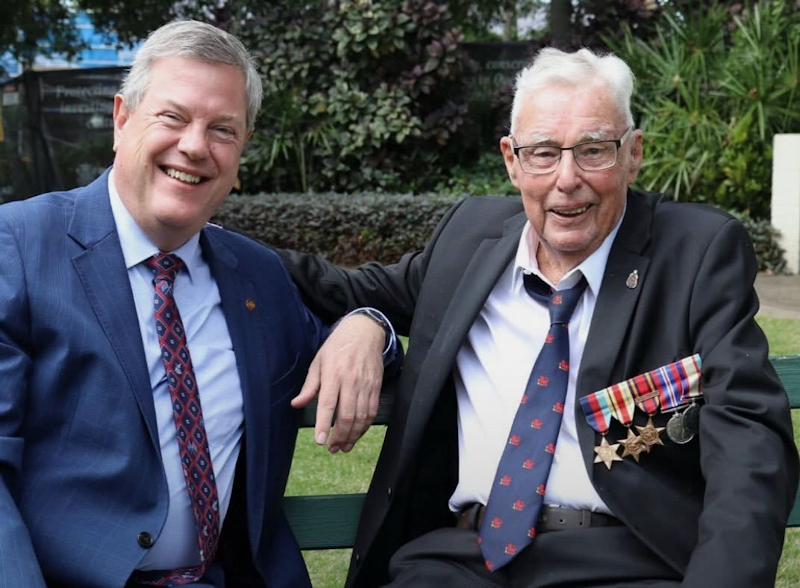
Even in his later years,
Bill’s enthusiasm for life, warmth and sense of humour
remained undiminished. He
was a remarkable Queenslander whose stories and service
helped keep an important chapter of our nation’s
history alive. Bill’s legacy of courage, service and
sacrifice will be remembered for generations to come.
Local MP Tim Nicholls (Photo: Bill & Tim)
Sources:
Sea Power Centre
Sunshine Coast News
Instagram
The Courier Mail
Maroochy RSL
Compiled by Laurie Pegler |
