Admiral
Sir Anthony Monckton SYNNOT, KBE AO
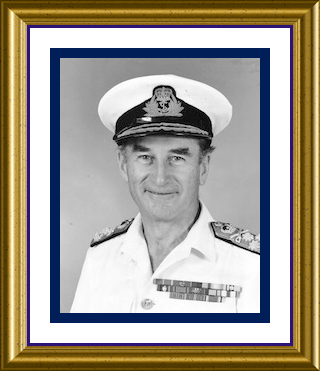 Anthony Monckton Synnot was born on 5 January 1922 at
Corowa, New South Wales. A descendant of Monckton
Synnot, brother of Captain Timothy Monckton Synnot and a
distant relative of the American,
Saint Elizabeth Ann Seton.
While he was young the family moved to Albury, New South
Wales and then to a remote sheep property at Eskdale, near
Longreach in Queensland. From age 12, Anthony (Tony)
was educated at Geelong Grammar in Melbourne, and for the
next five years he was immersed in school life, only
visiting his family at Christmas. Synnot was a solid
achiever at school and excelled at tennis, cricket and golf. Anthony Monckton Synnot was born on 5 January 1922 at
Corowa, New South Wales. A descendant of Monckton
Synnot, brother of Captain Timothy Monckton Synnot and a
distant relative of the American,
Saint Elizabeth Ann Seton.
While he was young the family moved to Albury, New South
Wales and then to a remote sheep property at Eskdale, near
Longreach in Queensland. From age 12, Anthony (Tony)
was educated at Geelong Grammar in Melbourne, and for the
next five years he was immersed in school life, only
visiting his family at Christmas. Synnot was a solid
achiever at school and excelled at tennis, cricket and golf.
In early 1939, at age 17, Synnot joined the RAN as a special
entry cadet midshipman. He was sent to Britain for
training at the Royal Naval College, Dartmouth, and after a
compressed seven month course he graduated as a Midshipman
in 1940. At Dartmouth he had gained course prizes for
signals, torpedo, anti-submarine and his specialty gunnery.
Synnot was promoted Sub-Lieutenant in late 1940 while
serving on HMAS Canberra. He then joined HMAS
Stuart in the Mediterranean under Captain Hector
Waller. After a near miss from attacking aircraft
early in 1941, Captain Waller asked his Midshipman ‘What
do you think of that then?’ to which Synnot replied, ‘Very
exciting, Sir’. Much more ‘excitement’
followed as Synnot served on Stuart at the Battle
of Matapan and during the evacuations of Greece and Crete.
He was Mentioned in Dispatches for bravery when ferrying
soldiers off the beach at Tolon, Greece, in strong wind,
heavy surf and under shellfire.
Synnot later served on
board HM Ships Barham and Punjabi.
He was onboard Punjabi when it was sunk in
collision with the battleship HMS King George V in
Arctic waters off Iceland in 1942.....
On May 1, 1942, while covering Russian Convoy PQ.15, HMS
Punjabi encountered dense fog. The ship was forced to turn
to avoid a floating mine and accidentally crossed the path
of the battleship HMS King George V. The massive battleship
rammed the destroyer amidships, slicing it in two. As the
stern sank, Punjabi's depth charges detonated underwater,
which caused severe damage to the battleship. Tragically, 49
of Punjabi's crew members were lost in the incident.
.....Paddling in the mid-winter
conditions, covered in engine oil, he was fortunately
rescued by another destroyer. Later in life, he joked
that the bill for the oil-fouled sheets where he slept on
board that destroyer followed him for the rest of the war.
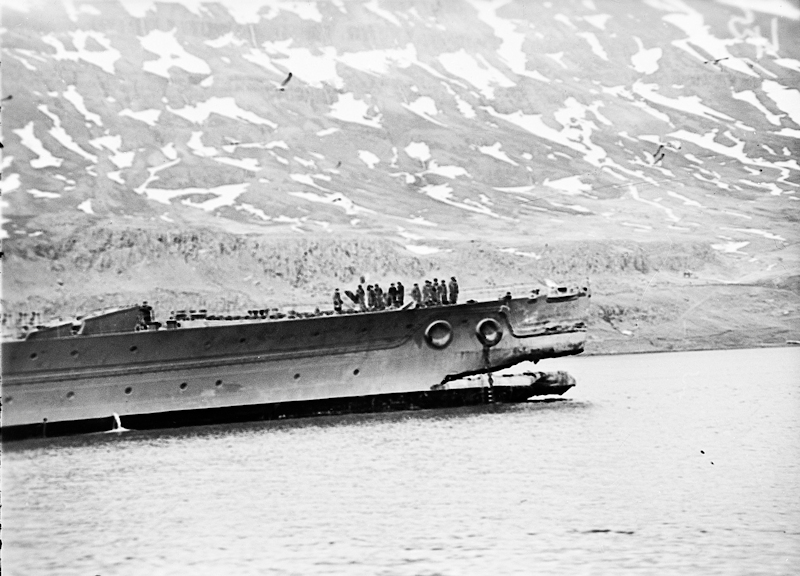
The bow of HMS King George V
showing damage following her collision with HMS
Punjabi
Synnot joined HMAS Quiberon in July 1942 and
remained on board until December 1944. He was promoted
Lieutenant in April 1942 and became the ship’s
second-in-command at age 22. After leaving
Quiberon he qualified as a specialist Gunnery Officer
at HMS Excellent, Whale Island, Portsmouth.
After the war he served in the aircraft carrier HMAS
Sydney on staff at Navy Office, and as an instructor at
HMS Excellent, being promoted to Lieutenant
Commander in 1950 and Commander in 1954. In 1956 he
commanded HMAS Warramunga during the Malayan
Emergency and as a guard ship for the yachting at the
Melbourne Olympic Games.
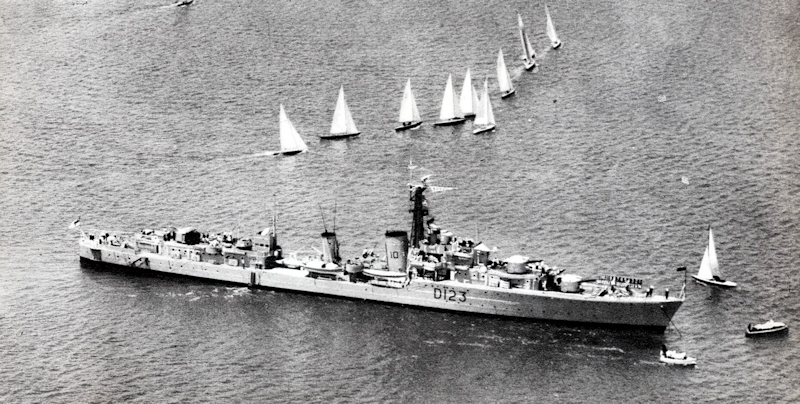
A member of the famous 10th
Destroyer Flotilla, HMAS Warramunga [I] shows her own sleek
lines to advantage and the yachts at the Olympics sailing
competition on Port Phillip Bay
Promoted to Captain in 1960,
Synnot commanded HMAS Vampire in operations in
south east Asian waters, including a visit to Saigon in
1962.
In 1950, Synnot had taken part in the Bridgeford Mission to
Malaya, which advised the Australian govern ment
on the Malayan Emergency. Because of his involvement,
he left Vampire to become Chief of
Naval Staff for the Royal Malaysian Navy, a position which
he held from 1962 to 1965. His efforts helped
establish a strong naval tradition in Malaysia, and his
service was recognised when he was awarded the Order of
Chivalry 3rd class, Johan Mangku Negara, (3rd Grade of
Darjah Yang Mulia Pangkuan Negara). His tact, judgment
and energy were all instrumental in his success in this
complex environment. ment
on the Malayan Emergency. Because of his involvement,
he left Vampire to become Chief of
Naval Staff for the Royal Malaysian Navy, a position which
he held from 1962 to 1965. His efforts helped
establish a strong naval tradition in Malaysia, and his
service was recognised when he was awarded the Order of
Chivalry 3rd class, Johan Mangku Negara, (3rd Grade of
Darjah Yang Mulia Pangkuan Negara). His tact, judgment
and energy were all instrumental in his success in this
complex environment.
Unfortunately his stay in
Malaysia was interrupted by the illness of his wife,
Virginia. When she subsequently died in Australia,
Synnot’s sister Kitty Howson was able to care for his two
young daughters while their father was at sea.
In 1966 Synnot commanded HMAS Sydney on two voyages
to South Vietnam, carrying troops and equipment in support
of the Australian Army. On one of these occasions he
successfully berthed the 698 foot (213m) long aircraft
carrier in Sydney without tugs - his ship handling skills
receiving a loud cheer from the ship’s company. The
following year he commanded the aircraft carrier HMAS
Melbourne during the introduction of the A-4 Skyhawk
and Grumman S-2 Tracker aircraft. In the words of Vice
Admiral Sir Richard Peek, ‘the flagship never had a
better, more efficient and more loved Captain’.
During 1968 Synnot attended the Imperial Defence College in
London. He married his second wife Anne Colvin, the
daughter of Admiral Sir Ragnar Colvin, RN in the same year
before returning to Canberra. He was promoted to Rear
Admiral and appointed Second Naval Member in 1970, and
subsequently Deputy Chief of Naval Staff. In 1973 his
last sea-going command was as Flag Officer Commanding the
Australian Fleet.
Returning to Navy Office Canberra in 1974, he served as
Director Joint Staff on the Defence Force staff, and then as
Assistant Chief of the Defence Force staff. He was
prominent in organising relief operations after Darwin was
devastated by Cyclone Tracy on Christmas morning 1974.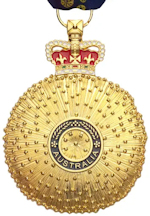
Synnot was promoted to Vice Admiral and appointed Chief of
Naval Staff (CNS) in November 1976. During the same
year he was also awarded an Order of Australia (AO).
While CNS he ensured the RAN developed an awareness of the
decision making processes within the Australian government
and administration. He emphasised good planning and
staff work, and improved systems and relationships between
the military and public service arms of the Department of
Defence. Although he recognised the need to buy the
United States built Guided Missile Frigates (FFGs) as a stop
gap measure, he consistently advocated renewal of an
Australian in-country shipbuilding effort.
In the 1972 New Year Honours list he was awarded a CBE
(Commander of the Order of the British Empire) and in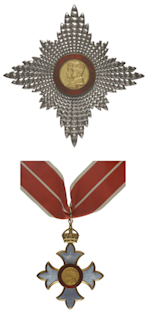 the 1979 New Year Honours list, which was officially
gazetted on December 30, 1978, it was upgraded to Knight
Commander of the Order of the British Empire (KBE).
The honour was awarded for his distinguished military
service in the Royal Australian Navy and his upcoming
appointment as Chief of the Defence Force Staff.
the 1979 New Year Honours list, which was officially
gazetted on December 30, 1978, it was upgraded to Knight
Commander of the Order of the British Empire (KBE).
The honour was awarded for his distinguished military
service in the Royal Australian Navy and his upcoming
appointment as Chief of the Defence Force Staff.
In April 1979 he was promoted to Admiral and became the
Chief of Defence Force Staff, a position he held until his
retirement in 1982. He initially persuaded the
government that the replacement of the ageing aircraft
carrier Melbourne was a high priority, and was
involved in the decision to buy HMS Invincible.
Later, he criticised the Fraser government’s economic
cutbacks when they ‘rescheduled’ a range of re-equipment
programmes, including the purchase of a replacement aircraft
carrier for the RAN. ‘Rescheduling’ was a euphemism
used to hide the loss of defence force capability without
directly over-ruling the individual Defence Force and
Service chiefs. Despite such setbacks Synnot was
always courteous, patient and thoughtful. His approach
was not adversarial, but rather he sought consensus through
systematic effort.
After retiring from the RAN he became Chairman of the
Council of the Australian War Memorial, a post that he
relinquished in 1985. Survived by his second wife Anne
and his four children Jane, Amanda, Zoe and Mark, he died on
4 July 2001 after a long illness and a number of years
suffering total blindness.
Synnot was one of the most highly respected officers ever to
serve in the Australian Defence Force. He had a presence
that simply commanded without ever raising his voice or
using theatrics. With strategic foresight and
determination he started a program to improve the equipment
capability of the Australian armed forces that would enable
Australia to play a significant military role as a leader in
the Asia-Pacific region.
Sources:
Sea Power Centre
Wikipedia
Royal Museums Greenwich
Herald and Weekly Times Ltd
Compiled by Laurie Pegler |
