Vice Admiral Sir Richard Innes Peek KBE CB DSC* US Legion of Merit
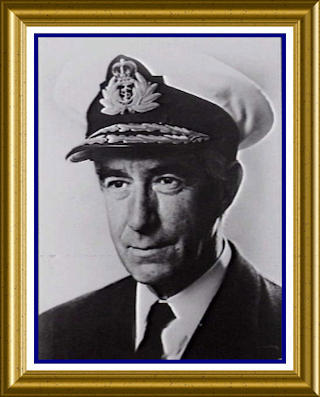 Richard
Innes Peek was born on July 30, 1914 at West Tamworth, the
son of James Peek and his wife, Kate Doughty. He
joined the Royal Australian Navy College in 1928 as a cadet
midshipman and graduated with maximum honours. During
his time there he let it be known that he preferred to be
known as
"Peter" because he disliked the ‘RIP’ monogram. Richard
Innes Peek was born on July 30, 1914 at West Tamworth, the
son of James Peek and his wife, Kate Doughty. He
joined the Royal Australian Navy College in 1928 as a cadet
midshipman and graduated with maximum honours. During
his time there he let it be known that he preferred to be
known as
"Peter" because he disliked the ‘RIP’ monogram.
After graduation his specialist
gunnery training followed with the Royal Navy, as was
typical of the era, at Whale Island, Portsmouth. He
was consolidating his training as a gunnery officer, serving
in the battleship HMS Revenge, at the outbreak of
the Second World War. In 1941 he
returned to Australia and served as a Lieutenant gunnery
officer in HMAS Hobart at the Battle of the
Coral Sea. Peek had personally—and unofficially—made
efforts to acquire extra anti-aircraft weapons for the
Hobart prior to the battle. These weapons proved
vital in defending the ship against the heavy Japanese air
attacks that occurred during the engagement. Under the
command of Rear Admiral John Crace, the Hobart was
part of a support group tasked with intercepting the
Japanese Port Moresby invasion force. On May 7, 1942,
Peek managed the ship's gunnery systems while the vessel was
heavily attacked by Japanese torpedo and high-level bombers.
Despite multiple near-misses and high-intensity strikes, the
ship survived without major damage.
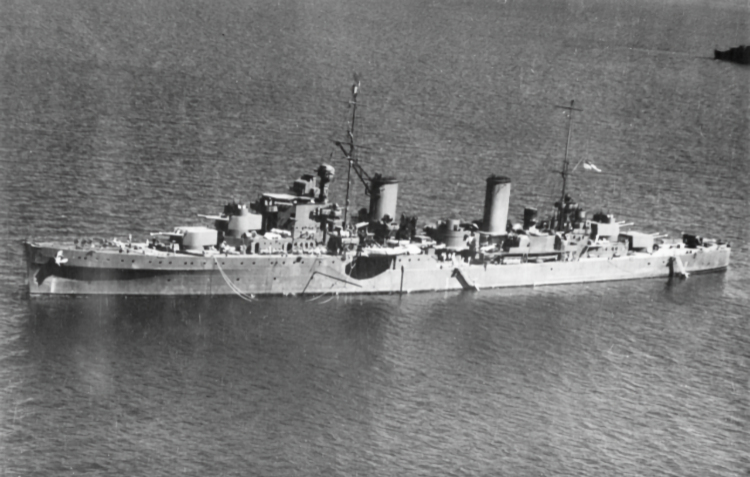
Aerial port side view of the
cruiser HMAS Hobart In
1943 he joined HMAS Australia as gunnery officer
until 1945. Also in 1943, he took time to marry
Margaret Seinor Kendall. Tragically, Margaret passed
away in 1946 due to complications while giving birth to
their son Matthew. While serving in
Australia, Peek suffered severe burns during the
kamikaze attack at the Battle of Leyte Gulf—that took the
lives of Captain Emile Dechaineux and thirty others—and for
his efforts immediately after was made an Officer of the
Order of the British Empire (OBE) for his "Skill,
determination and courage" during the
battle.
Then, during the Battle of Lingayen
Gulf, as the Squadron Gunnery Officer, his role was
critical, as the ship faced an unprecedented onslaught of
suicide attacks while providing shore bombardment for the
Allied invasion of Luzon. He was responsible for the
ship’s defensive fire during a period where Australia
was hit by kamikazes five times in just four days. He
oversaw the gunnery supporting the U.S. 6th Army's landings,
directing the cruiser's main batteries against Japanese
coastal positions. For his "gallantry and skill"
during the subsequent Lingayen Gulf operations, he was
awarded the Distinguished Service Cross (DSC).
Lieutenant Commander Peek was posted to England after the
war to undertake the Staff Course at the Royal Naval
College, Greenwich, and also led the RAN contingent at the
London victory celebrations on 8 June 1946, then the
following year he attended the Joint Services Staff College.
After returning to Australia Peek served in various
positions before his promotion to Commander. From 1951
he served as Commanding Officer of HMAS Shoalhaven
as Commander of the First Frigate Squadron, before going on
to command HMAS Bataan.
During the Korean War, he commanded
the destroyer HMAS Tobruk. Under his command,
Tobruk was heavily involved in the "war of the
islands" off the west coast of Korea. He directed the
ship's 4.5-inch guns to destroy North Korean supply lines,
trains, and coastal batteries. She also served as a
protective screen for Allied aircraft carriers, including
HMS Glory and USS Bataan, guarding them
against potential submarine or air threats while they
launched strikes. Peek and his crew became famous for
their accuracy in destroying enemy supply trains along the
rugged coastline, a dangerous task that required getting the
ship very close to shore. They were referred to as the
Train Busters Club. For his leadership and
"distinguished service" during the conflict, he was awarded
a Bar to his Distinguished Service Cross in 1952.
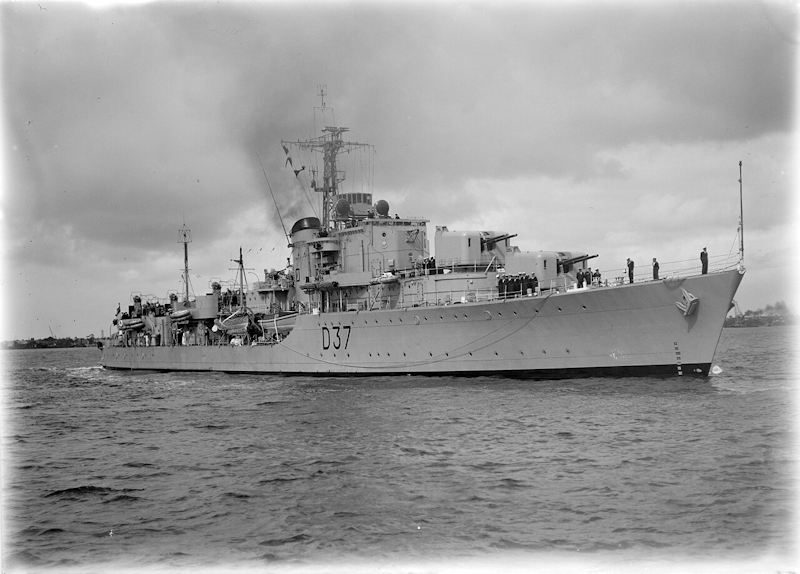
HMAS Tobruk in 1952
This period was also significant personally, as in 1951, he
married his second wife, Mary "Catherine" Tilley Stops, just
as his command of Tobruk was beginning.
They remained married for 54 years until her death in 2005.
From 1954 he served as Deputy Chief of Naval Personnel.
After promotion to Captain he again commanded HMAS
Tobruk from 1956 to 1958 and was also Captain
(Destroyers) of the 10th Destroyer Squadron. In this
period, he served in the Far East Strategic Reserve.
During an exercise, one of his sailors was killed and
another seriously wounded. A star-shell from a Royal
Navy ship had hit his own. Tobruk and the
accompanying HMAS Anzac had also conducted naval
gunfire support missions against communist bandits operating
in East Johore. This period had a
marked effect on Peek. It galvanised him on a personal
crusade to seek repatriation benefits for all those naval
personnel who had participated in the Malayan Emergency.
Ever upwards, Peek climbed the tall command tree. He
had passed all the professional staff exams which prepared
him for it, including attendance at the 1961 Imperial
Defence College course in London. His rise was assured.
From 1962 he commanded the aircraft carrier HMAS Sydney,
and then the aircraft carrier and RAN flagship HMAS
Melbourne. In 1964 he was
promoted to Rear Admiral and appointed as the Fourth Naval
Member and Chief of Supply of the Australian Commonwealth
Naval Board. From 1965 to 1967, he was Deputy Chief of
Naval Staff, and from 1967 was Flag Officer Commanding HM
Australian Fleet, which included oversight of the British
Commonwealth's Far East Strategic Reserve. During this
period the RAN first participated in naval bombardment
operations against North Vietnam, beginning with HMAS
Hobart. In 1968, he was appointed as Second Naval
Member and Chief of Personnel.
Peek was promoted to Vice Admiral in
1970 on appointment as Chief of Naval Staff. On 1
January 1971, he was appointment as a Companion of the Order
of the Bath (CB). He was further honoured, on 1
January 1972, when he was Knighted via appointment as a
Knight Commander of the Order of the British Empire (KBE).
During his three-year tenure, the RAN's involvement in the
Vietnam War ended, and he was heavily involved in
restructuring the Navy as a result of the decision by the
Whitlam government to combine the separate departments of
the Navy, Army, and Air into the Department of Defence.
Plans were well advanced for an Australian light destroyer
(designated "DDL") and an RAN replenishment ship. The
Australian government changed in 1972 and, due to the new
Whitlam government's opposition to the planned DDL project,
in August 1973 Peek advised the Government to not proceed.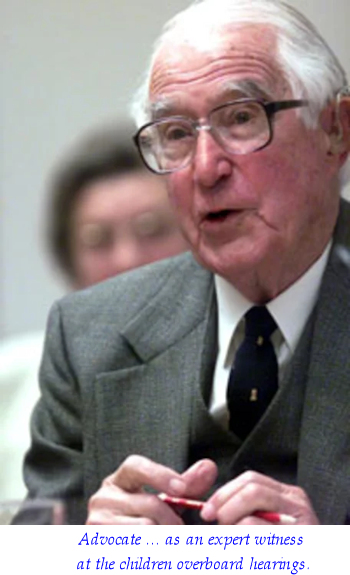
Retirement and later life
Peek retired on 22 November 1973, and became a pastoralist
in Monaro district of southern New South Wales near Cooma.
He remained active in naval and military affairs, and
campaigned for the welfare of veterans. His many
activities included:
-
Navy League of
Australia - member, Advisory Council
-
In 2002, aged 87,
he gave evidence at the Australian Senate inquiry into
the "Children Overboard affair", vigorously defending
Commander Norm Banks, Commanding Officer of HMAS
Adelaide and the crew. He strongly denounced
the Howard government's handling of the incident.
He described the government's ban on military personnel
speaking to the media about the incident as a
"Nazi-style" tactic, aimed at suppressing the truth.
Peek noted there was widespread disgust among naval
personnel regarding how the government handled the
incident. He acted as a vocal critic during the
scandal, in which the government falsely alleged that
refugees had thrown their children overboard to force a
rescue, a claim that was later proven to be untrue and
used for political gain.
-
Championing the Far
East Strategic Reserve Association.
-
In 2004, Peek was the
original Patron of "A Just Australia" group, made up of
43 former military chiefs, diplomats, and senior public
servants who publicly denounced the Howard government's
decision to join the Iraq War. Known for his
honesty and "intolerance of humbug," Peek felt the
official condemnation of the war was not strong enough.
His specific criticisms included:
-
Intelligence and Deception: The group
argued that Australia's involvement was based on
deception regarding weapons of mass destruction
(WMD) and that the government had not been
transparent with the Australian public.
-
National Security: Peek and his
colleagues maintained that the war had actually made
Australia a bigger target for terrorism and had not
served the nation's long-term interests.
-
Political Clashes: Despite his
military background, Peek's involvement carried
significant weight because he had a history of
clashing with both sides of politics over defence
policy.
The Howard government responded
sharply to these criticisms; one member famously
dismissed the group as "doddering daiquiri diplomats", a
jibe that was widely considered disrespectful given
Peek's decorated service as a combat veteran.
-
His "A Just
Australia" group also fought for just policies and
programs for refugees and asylum seekers.
-
In 2009, he
provided expert advice to the Australian Parliament
regarding the 2009 Defence White Paper, Defending
Australia in the Asia Pacific Century: Force 2030.
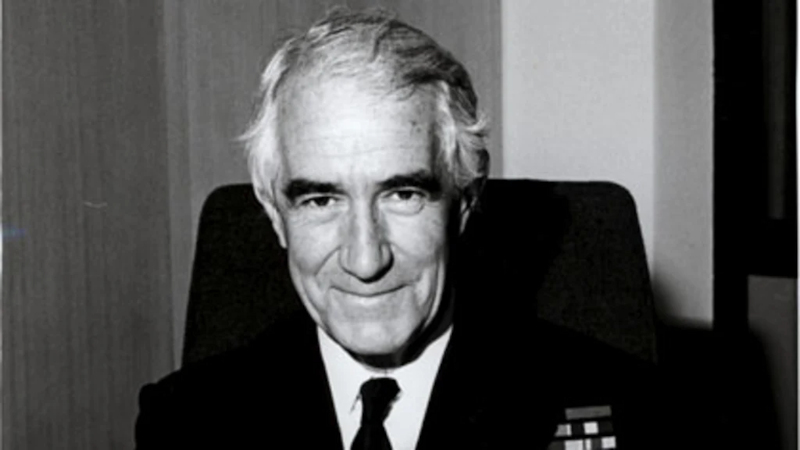
Sir Richard Peek ...
publicly denounced the Howard government over the Iraq war.
Death and Legacy Sir Richard Peek passed away
in Canberra on 28 August 2010,
at the age of 96. He is survived by his:
Children: Matthew, Jane and Rachel;
Grandchildren: James, Catherine,
David, Elizabeth, John and Eleanor;
Great-grandchildren: Alexander, Luke
and Natalia.
He is remembered as one of the RAN's most
respected seagoing commanders, a leader who combined a
"fearsome" disciplinary reputation with a genuine concern
for the welfare of the sailors under his command. -o-o-O-o-o- Sources:
Wikipedia
The Sydney Morning Herald
Australian War Memorial
Sea Power Centre
The Sunday Times
Compiled by Laurie Pegler |
