COASTWATCHER
Lieutenant Commander
Paul Edward Allen MASON DSC(U.S.)
DSC(U.K.)
RANVR
An extraordinary man
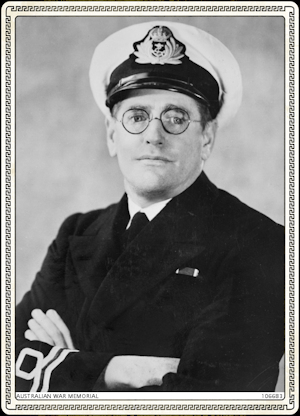 Paul Edward Allen Mason was far from the
stereotypical image of a military hero.
Short, bespectacled, and often described as
"unprepossessing," he was an Australian plantation
manager who became one of the most critical
intelligence assets in the South Pacific during
World War II. Admiral William "Bull" Halsey,
Commander of the South Pacific Area, famously
remarked that the intelligence provided by
Coastwatchers like Mason "saved Guadalcanal, and
Guadalcanal saved the South Pacific." Paul Edward Allen Mason was far from the
stereotypical image of a military hero.
Short, bespectacled, and often described as
"unprepossessing," he was an Australian plantation
manager who became one of the most critical
intelligence assets in the South Pacific during
World War II. Admiral William "Bull" Halsey,
Commander of the South Pacific Area, famously
remarked that the intelligence provided by
Coastwatchers like Mason "saved Guadalcanal, and
Guadalcanal saved the South Pacific."
Early Life and the Call of the Tropics
Born on April 30, 1901, in North Sydney, Paul Mason
was the son of a Danish master mariner who had
changed his name from Mikkelsen to Mason.
Though he briefly attended the prestigious Fort
Street Boys’ High School, Mason was primarily a
self-taught man who valued practical
skills—navigation, mechanics, and radio
operation—over formal academics.
At just 14 years old, Mason followed his
half-brother to the Shortland Islands to manage a
trade store. After a brief return to
Australia to work on a family orchard in Penrith,
the lure of the islands proved irresistible.
In 1925, he moved to Bougainville to manage Inus
Plantation. It was a grim beginning; his
predecessor had been killed by the plantation
laborers. However, Mason’s fair treatment and
deep respect for the local people allowed him to
succeed where others had failed. He spent
nearly two decades trekking across Bougainville,
gaining an intimate knowledge of its rugged terrain
and forging bonds with its inhabitants that would
later prove life-saving.
The Coastwatcher: "Twenty-four Bombers
Headed Yours"
When World War II broke out, the Australian Naval
Intelligence Division activated the Coastwatchers—a
network of planters, missionaries, and government
officials tasked with staying behind enemy lines to
report on Japanese movements. Mason, despite
being "overage, undersized, and slightly deaf,"
refused evacuation when the Japanese invaded
Bougainville in 1942.
To provide him with some legal protection if
captured, he was commissioned as a Petty Officer
(and later Lieutenant) in the Royal Australian
Naval Volunteer Reserve (RANVR). Carrying a
heavy, cumbersome "teleradio" through the dense,
mountainous jungle, Mason established an
observation post on Malabita Hill, overlooking the
Japanese-held waters of the southern Solomon
Islands.
The Turning Point at Guadalcanal
Mason’s most legendary contribution occurred on
August 7, 1942, during the opening of the
Guadalcanal campaign. From his vantage point,
he spotted a massive formation of Japanese aircraft
flying south from Rabaul. He tapped out a
brief, urgent message:
"Twenty-four torpedo bombers headed yours."
This warning gave the U.S. fleet at Guadalcanal
over two hours of lead time. By the time the
Japanese arrived, American fighters were already in
the air, and anti-aircraft guns were manned.
The result was a slaughter: nearly every Japanese
bomber was destroyed. These early warnings
became a regular occurrence, forcing the Japanese
to realize that someone on Bougainville was
watching their every move.
In about August 1942, Mason reported Japanese air
reconnaissance over the flat land near Buin.
In September the natives reported that the Japanese
appeared to be establishing themselves in the area.
Mason observed tractors, lorries, guns and other
equipment being landed in the area. He moved
inland but continued to report aircraft movements.
Some friendly natives would mingle with the
Japanese and then report back info to Mason. One of
his signals back to Townsville read as follows:-
0302Z 23rd
(September 1942).
"Our scouts being employed Kahili aerodrome state
aerodrome is expected to be completed in a week's
time. Many hundreds of natives being forced
to work on aerodrome. 27 lorries, 6 motor
cars, 10 horses, 6 motor cycles, 4 tractors and
aerodrome working equipment at Kahilia.
Stores and fuel under tarpaulins spread along
foreshore from mouth of Ugumo River to mouth of
Moliko River. Two anti-aircraft guns near
mouth of Ugumo River in fuel and ammunition dump
and one anti-aircraft gun on north-western boundary
of aerodrome. Wireless station on beach in
front of aerodrome, also eight new iron buildings.
Priests and nuns interned in iron buildings on
beach. Enemy troops in green uniforms with
anchor badge on arm and on white hat. Scouts
state 440 enemy troops but coolies too numerous to
count. Weather too hazy to observe ships
today."
More Japanese ships started to anchor in the area
between Buin and the Shortlands. Mason had
difficulty identifying some of them so the next
supply drop included photographs of some of the
pages out of "Jane's Fighting Ships".
When the Japanese tried to recapture Guadalcanal in
November, Mason's report on 10 November 1942
advised that:
At least 61 ships this area, viz. 2 Nati, 1 Aoba, 1
Mogami, 1 Kiso, 1 Tatuta, 2 sloops, 33 destroyers,
17 cargo, 2 tankers, 1 passenger line of 8,000
tons.
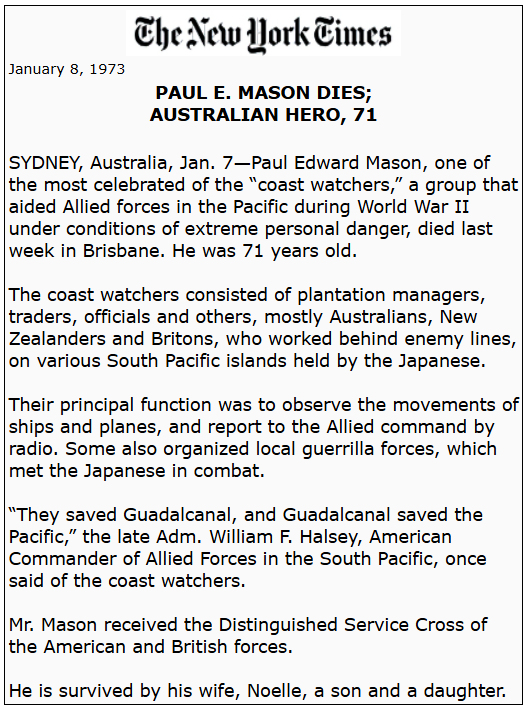
Paul was promoted to Lieutenant in the November,
and was awarded the US Distinguished Service Cross.
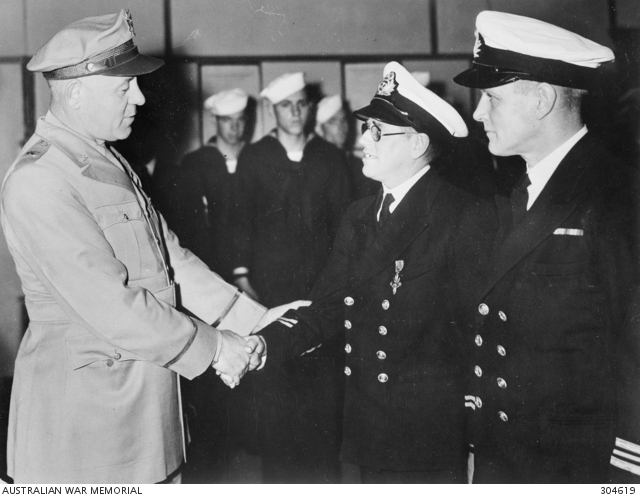
Lieutenant Paul
Mason is presented with an American Distinguished
Service Cross
for extraordinary heroism as a Coastwatcher.
Survival and Guerilla Warfare
The Japanese eventually launched a massive manhunt
for the "radio man." Mason was forced to flee
through the jungle, often barefoot and starving,
carrying only a pistol and a small rucksack.
In one instance, he and his party escaped a 100-man
Japanese search unit by scaling the 5,000-foot
Keriaka Plateau.
After many days of walking, Mason developed a
festering sore on his foot. He removed his boot and
as he removed his sock, to his horror, skin and
flesh came away with it. Mason rested up for 2 days
to gather his strength.
After being evacuated by submarine in July 1943 due
to exhaustion and illness, Mason’s devotion to
Bougainville remained unshaken.
Guerrilla Operations: 1944–1945
When Mason returned to Bougainville in late 1944,
his role shifted from passive observer to active
combatant. The Japanese 17th Army was still
40,000 strong on the island, though they were cut
off from supplies. He organized a partisan
band of local scouts who engaged in fierce
guerrilla warfare.
Despite the violence of the era, Mason was noted
for his humanity. He led daring rescues of
former prisoners and missionaries and famously
refused to take vindictive action against locals
who had been forced to collaborate with the
Japanese.
To dive deeper into the technical and tactical side
of Paul Mason’s war, we have to look at how he
managed to survive while being hunted by thousands
of Japanese troops. His success relied on two
pillars: the AWA Teleradio 3BZ and his mastery of
asymmetric guerrilla warfare.
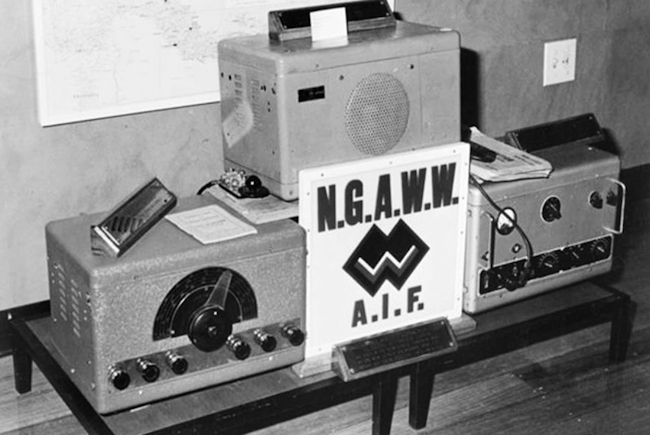
AWA Teleradio 3BZ
used by coastwatchers during the war.
The Technology: The Teleradio 3BZ
The "voice" of the Coastwatchers was the Teleradio
3BZ. For a man like Mason, who was often on
the run, this piece of equipment was both his
greatest weapon and his heaviest burden.
-
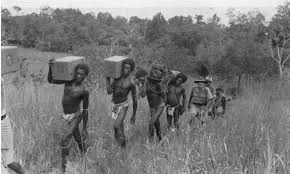 Portability vs. Weight:
The unit weighed roughly 100 lbs (45 kg) when packed
with its heavy lead-acid batteries and engine-driven
generator. It required a team of 12 to 16 local
carriers to transport the radio, fuel, and supplies
through the steep, muddy tracks of Bougainville. Portability vs. Weight:
The unit weighed roughly 100 lbs (45 kg) when packed
with its heavy lead-acid batteries and engine-driven
generator. It required a team of 12 to 16 local
carriers to transport the radio, fuel, and supplies
through the steep, muddy tracks of Bougainville.
-
The Antenna: To
get a signal out of the deep jungle to the base in Vila
or Darwin, Mason had to string long-wire antennas
between trees, often at great heights. This made
his position vulnerable to direction-finding equipment
if he stayed in one place too long.
-
The Signal:
Mason primarily used Morse code for its reliability over
long distances, though he would use voice for urgent
warnings, such as the famous Guadalcanal alert.
The "Mason Force"
Mason didn't lead a traditional army; he led a
group of Bougainvillean partisans. His
tactics were centered on:
-
Ambushes:
Using his intimate knowledge of the Inus and Kieta
tracks, Mason’s scouts would strike Japanese foraging
parties, seizing weapons and food.
-
Psychological
Warfare: By maintaining a presence across the
island, Mason made the Japanese feel surrounded, even
when the actual number of Allied troops was small.
-
Intelligence for
Air Strikes: Mason would pinpoint Japanese
headquarters or supply dumps and "talk" Allied bombers
onto the targets using his radio.
The numbers are staggering:
his small, mobile force is credited with the deaths of 2,288
Japanese soldiers during this final phase of the war.
Despite the high-intensity combat, Mason's primary concern
remained the safety of the local villages caught in the
crossfire.
A handful of men
In the dense jungles of
Bougainville, the war was won not just by divisions of
soldiers, but by a handful of men with radios. To
understand Paul Mason’s impact, one must also look at his
counterpart, Jack Read, and the specific locations from
which they watched the horizon.
The "Twin Eyes" of
Bougainville: Paul Mason & Jack Read
While Paul Mason watched the south,
William John "Jack" Read guarded the north. A former
Assistant District Officer, Read was Mason’s tactical
mirror. Together, they formed an inescapable
intelligence net.
-
Jack Read
(Northern Bougainville): Based near Buka
Passage (the narrow channel separating Buka Island and
Bougainville), Read overlooked the Japanese airfields
and naval anchorages in the north. On August 8,
1942—just one day after Mason’s famous warning—Read
radioed: "Forty-five dive-bombers going
south-east." This second warning was
equally vital in protecting the American beachhead at
Guadalcanal.
-
The Partnership:
Although they operated independently, they coordinated
to track Japanese forces as they moved from the major
bases in Rabaul down the "Slot" toward the front lines.
Strategic Observation Posts
Mason and Read didn't just pick any
hill; they chose locations that offered specific technical
and visual advantages.
1. Malabita Hill (The
Southern Watch)
This was Mason’s primary post during
the most critical months of 1942.
-
Location:
Inland from Buin and Kangu on the southern coast.
-
Strategic Value:
It provided a panoramic view of the Shortland Islands
and Fauro Island, where the Japanese Navy assembled
their massive "Tokyo Express" convoys.
-
The Sight:
From here, Mason could see Japanese tractors, guns, and
thousands of troops landing on the beaches below.
He even used a copy of Jane’s Fighting Ships dropped to
him by the RAAF to identify specific Japanese cruisers
and destroyers by name.
2. Porapora (The
Northern Watch)
This was Jack Read’s "eyrie" in the
mountains of North Bougainville.
-
Location:
A rugged hideout overlooking Buka Passage.
-
Strategic Value:
This location captured every flight taking off from the
Buka and Bonis airfields. Because the flight path
to Guadalcanal led directly over the center of the
island, any aircraft Read missed would be picked up by
Mason minutes later.
3. The Keriaka Plateau (The
Survival Retreat)
When the Japanese launched
"Operation Coastwatcher" to hunt them down with
dogs and 100-man patrols, both men retreated into the
Keriaka Plateau.
-
Terrain:
This is a massive limestone formation with cliffs 5,000
feet high.
-
Tactical Use:
It was virtually inaccessible to anyone without local
guides. Mason and Read used this as a "dead zone"
where they could disappear when the heat became too
intense, only to emerge weeks later at a new hilltop to
resume broadcasting.
The "STO" Signal
Every radio station had a call sign.
Mason’s was STO—the initials of his married sister.
For the U.S. Navy commanders in the Solomons,
"Message from STO" became the most trusted words in
the Pacific. It meant the difference between being
caught at anchor and being ready for a fight.
A Legacy of Respect
What truly set Mason apart from
other colonial-era figures was his post-war transition.
While many planters struggled to adapt to the changing
social climate of Papua New Guinea, Mason was respected as a
"man of the people." When he stood for the Legislative
Council, he didn't campaign on his war record; he campaigned
on the need for roads, schools, and medical facilities for
the people who had hidden him from the Japanese.
His life reminds us that the
"unprepossessing" person in the room is often the one
holding the most power—and the most courage.
Post-War Career and Legacy
After the war, Mason returned to his
beloved Inus Plantation. He was no longer the "unkempt
eccentric" of the pre-war years but a celebrated hero.
He was awarded both the U.S. Distinguished Service Cross
(presented by General Douglas MacArthur) and the British
Distinguished Service Cross.
Political Life and Community
In 1947, he married Noelle Taylor, a
journalist and psychologist. Together, they expanded
their business interests, opening the Chimbu Lodge and Buka
Store. Mason remained a vocal advocate for the
development of Bougainville. In 1961, he was elected
to the Legislative Council of Papua and New Guinea, where he
served until 1964. He was known as a pragmatic voice,
often wary of premature independence, fearing the
administrative challenges the territory would face.
The Final Signal
In late 1971 Mason was admitted to
hospital in Bougainville. He was subsequently
transferred to Greenslopes Repatriation General Hospital in
Brisbane, where he died on
December 31, 1972, at the age of 71. His legacy is
etched into the history of the Pacific War—a man who proved
that local knowledge, technical ingenuity, and quiet courage
could alter the course of global conflict.
|
Award |
Country |
For Service |
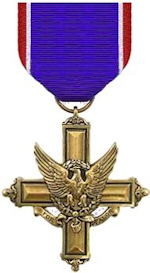
Distinguished Service Cross
|
United States |
"For extraordinary heroism in connection with
military operations against an armed enemy as a
Coast Watcher in action against enemy forces in the
Southwest Pacific Area." |
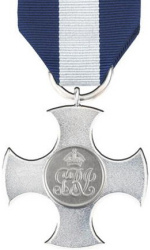
Distinguished Service Cross
|
United Kingdom |
"For great skill and outstanding devotion to duty in
special operations in the Far East." (1944-45) |
|
Promotion to Leut. Commander |
Australia |
Post-war recognition in RANVR |
Legacy Note:
Admiral Halsey’s tribute—"The Coastwatchers
saved Guadalcanal, and Guadalcanal saved the South Pacific"—is
often quoted, but it was specifically the data from Malabita
Hill and Porapora that made that salvation possible.
Sources:
Australia At War
Anzac Portal
Australian Dictionary of Biography
Wikipedia
Traces of War
Grokipedia
Vintage and Military Amateur Radio Society
Australian War Memorial (P01035.006)
The New York Times
-o-o-O-o-o-
NOTE:
More than 600 Coastwatchers served in
Australia, New Guinea and the Pacific islands during World
War II. They were often cattle-station managers,
missionaries and plantation managers stationed on remote
islands. They played a key role in Australian military
intelligence. It was a lonely and dangerous job. The
Japanese tortured and killed Coastwatcher Percy Good, an
elderly copra planter on Buka Island, off Bougainville.
After Good's death, all civilian Coastwatchers were enlisted
into the Royal Australian Navy. It was believed this would
protect them if they were captured.
Compiled by Laurie Pegler |
