LCDR Arthur Henry CALLAWAY DSO RANVR
(and the brave men of H.M. Trawler Lady Shirley)
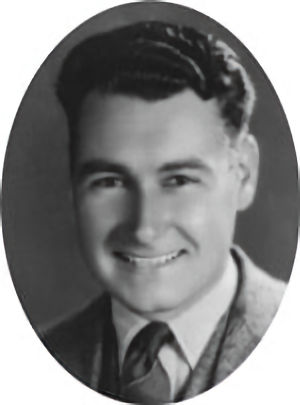 Arthur
Henry Callaway, accountant and naval officer, was born on
3 April 1906 at Woollahra, Sydney, son of Arthur Henry
Callaway, vocalist, and his wife Cecilia Frances, née
Thomson, both Sydneysiders. Educated at Bondi Superior
Public School, by 1923 young Arthur was a clerk with
Rosenfeld & Co. Pty Ltd, merchants. Arthur
Henry Callaway, accountant and naval officer, was born on
3 April 1906 at Woollahra, Sydney, son of Arthur Henry
Callaway, vocalist, and his wife Cecilia Frances, née
Thomson, both Sydneysiders. Educated at Bondi Superior
Public School, by 1923 young Arthur was a clerk with
Rosenfeld & Co. Pty Ltd, merchants.
He joined the Royal Australian Naval Reserve on 1 July
1924 as a Midshipman and in June 1939 transferred to the
Volunteer Reserve with the rank of Lieutenant. His
recreations were yachting and rowing; in 1931-33 he was
honorary treasurer of the Sydney Rowing Club. An
associate-member of the Federal Institute of Accountants,
from the early 1930s Callaway practised in the city.
On 23 November 1935 in St Michael's Anglican Church,
Vaucluse, he married Thelma May Rowe.
Having specialised in anti-submarine warfare, Callaway was
promoted Lieutenant Commander on 23 June 1939. He
was mobilised in September and served in HMAS Yarra
until March 1940. Lent to the Royal Navy, in
November he sailed for England. In June 1941 he
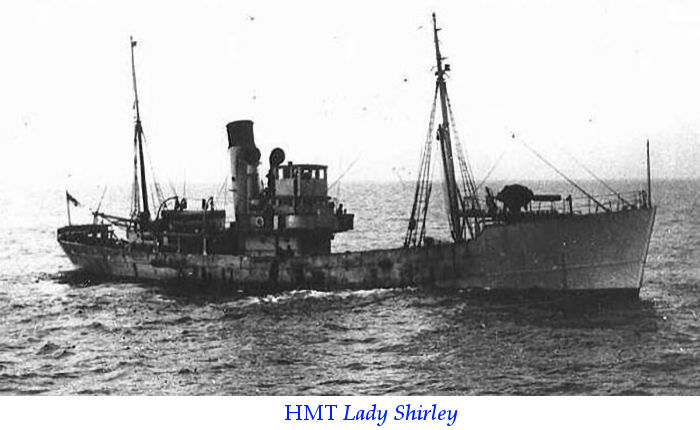
assumed command of H.M. Trawler, Lady Shirley,
which operated from Gibraltar; of 477 tons gross, she and
similar vessels had been requisitioned for patrol duties.
Tall, blue eyed and bearded, Callaway was a quiet,
reflective and purposeful man who trained his crew
thoroughly and ran a happy ship. On 4 October
Lady Shirley was searching for a merchantman lying
damaged 400 nautical miles (741 km) west of the Canary
Islands. These were dangerous waters infested by
German U-boats ever watching and waiting for the helpless
merchantmen.
The morning had dawned bright and clear, with a little
wind and a long low swell. A German U-boat, U111,
a submarine of 750 tons, measuring 245 feet in length, lay
on the surface, her crew enjoying the early morning sun.
She was commanded by Kaptain-Leutnant Wilhelm
Kleinschmidt, an experienced underwater sailor with a crew
of fifty-one, which included 4 other officers and a
prospective captain Korvetten-Kapitan Heinecke. The
sea, as far as the eye could see, was empty, but unknown
to Kleinschmidt, beyond his gaze as he scanned the
horizon, lay the U-boats nemesis.
At 8.40am, Lady Shirley altered course to
investigate a sighting, soon confirmed to be the conning
tower of a German U-boat. Meanwhile Kleinschmidt had
sighted smoke from Lady Shirley’s funnel and
though not alarmed, decided to dive.
More than one and a half hours passed until at 1004
Commander Callaway’s patience was suddenly rewarded by an
unmistakable contact. A pattern of depth charges was
dropped, none of which damaged U111, but they
certainly disturbed her crew. Kleinschmidt decided
to surface, and barely had the rumble of the exploding
canisters died away before the crew of the Lady
Shirley sighted the periscope rising from the depths.
Callaway swung his ship hard aport to bring his single
4inch gun to bear, and as the Conning tower slowly
emerged, his gun crew opened fire at 500 yards range.
The Germans running along the submarine’s deck to man the
forward 4.1inch gun were sprayed with machine gun fire and
either killed or driven back. The survivors,
however, opened fire with a machine gun and killed the
gun-layer in Lady Shirley, whose place was taken
by Sub-Lieutenant Frederick French, RNR, who scored three
hits in rapid succession.
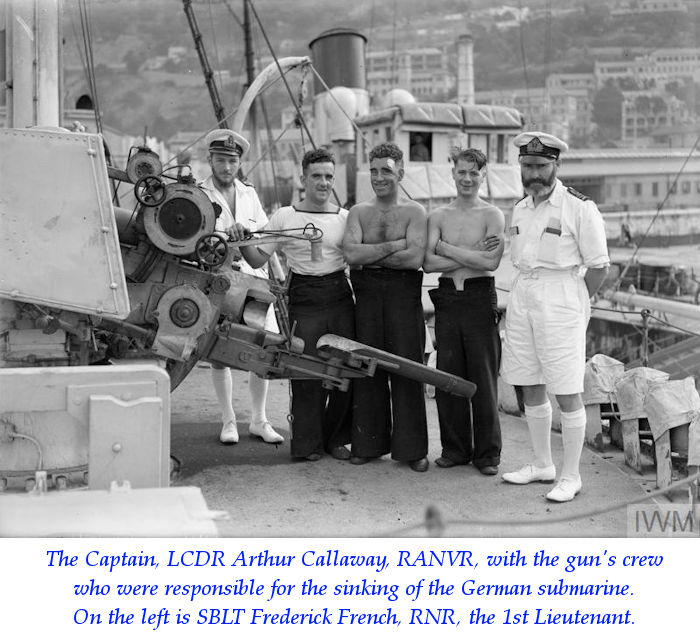
The action lasted for another twenty minutes during which
several of Lady Shirley's crew were severely
injured and eight Germans, including the submarine
Captain, died. The 4-inch fire eventually proved
effective and with the U-boat badly damaged and already
sinking by the stern the surviving senior officer ordered
abandon ship. Forty-four Germans were taken from the
water, one of whom was moved to comment .....
.....“we were bigger than you, we could see you, but
you couldn’t see us yet you beat us.”
The trawler’s crew of thirty, then had the problem of
containing forty-four surviving German POWs for the return
trip to Gibraltar.
This was the first time that POWs were captured from a
U-boat operating in the South Atlantic. German
survivors claimed that U-111 was the first U-boat
to be lost of those operating in that area.
The action had taken place in position 27.15N, 20.27W
south west of Tenerife.
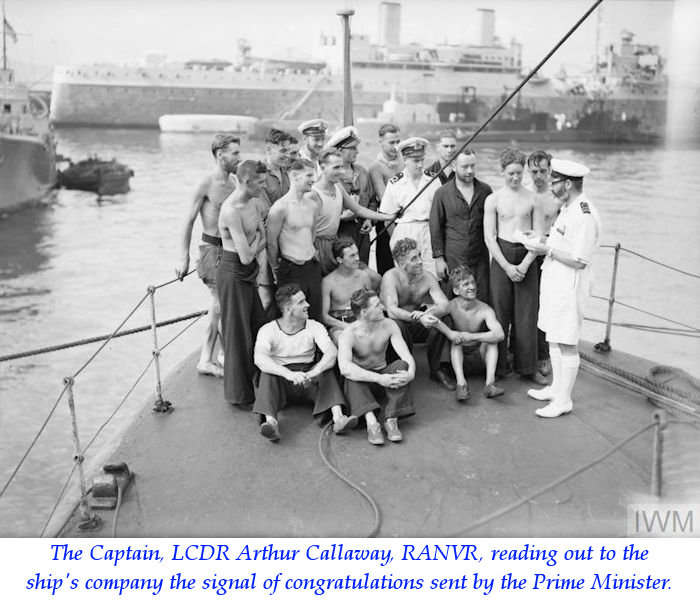
 On
October 14 1941, Lieutenant-Commander Henry Callaway RANVR
was awarded the Distinguished Service Order..... On
October 14 1941, Lieutenant-Commander Henry Callaway RANVR
was awarded the Distinguished Service Order.....
..... ”For great daring and skill in a brilliant
action against a U-boat”.
His First Lieutenant, another Australian, Lieutenant
Ian Penn Boucaut RANVR, was awarded the DSC. In all,
another DSC, five Distinguished Service Medals, a
Conspicuous Gallantry Medal and six Mentioned in
Despatches were awarded to the members of the crew.
The King has been graciously pleased to approve the
following Awards: —
For daring and skill in a brilliant action against a U
boat in which the Enemy was sunk and surrendered, to H.M.
Trawler Lady Shirley:
 The
Distinguished Service Cross The
Distinguished Service Cross
Lieutenant Ian Penn Boucaut, R.A.N.V.R.,
Temporary Sub-Lieutenant Frederick Edward French, R.N.R.
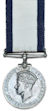 The
Conspicuous Gallantry Medal The
Conspicuous Gallantry Medal
Seaman Sidney Halcrow, who was so badly wounded that he
was ordered to go below, but stood to his gun until the
action was over, when he passed out.
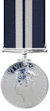 The
Distinguished Service Medal The
Distinguished Service Medal
Leading Seaman William Henry Mackrill, R.N.R.
Seaman George Alec Bussey,
Seaman Albert Milne,
Seaman William Windsor,
Stoker Ian Robert McCready,
 Mention
in Despatches (Posthumous) Mention
in Despatches (Posthumous)
Seaman Leslie William Pizzey
Mention
in Despatches
Chief Engineman George Alex Wyatt
Seaman Kenneth Francis Hibbs
Seaman Andrew Mclnenny
Ordinary Signalman James Henry Warbrick
Stoker Ronald Summers
Unfortunately none of the crew lived to receive their
decorations as these brave men and the gallant Lady
Shirley disappeared without trace while patrolling
the western approaches to the Straits of Gibraltar between
3 and 4 a.m. on 11 December 1941. It was later
concluded from German records that she had been torpedoed
and sunk by a U-boat (U374) at 35°15'N, 5°26'W.
Arthur Henry
Callaway was survived by his wife and daughter, and by his
son Ian, who followed in his fathers footsteps and joined
the Royal Australian Navy, rising to the rank of
Commodore.
_______________________________________________________________________________
Sources:
Australian Dictionary of Biography
Naval Historical Society of Australia
Australian War Memorial
The London Gazette Friday 14th November 1941
Compiled by Laurie Pegler |
